Tuesday, April 1, 2014

Fishing


Fishing is rapidly getting hip! Forget about planking, selfies and digital shit and grab a fishing rod!


Photos by Vahur Afanasjev, 30 March 2014 in Tartu by the river Emajõgi. Oh and btw there's a pile of snow across the river - will take a month to melt it.

Monday, March 31, 2014

Double-decker Woodshed


Dunno how was in London, Paris or New York of olde dayz but in Estonian towns most of the people lived pretty much side by side, especially in the center. Interesting contrast to really lofty living conditions in the countriside (our population density is approxiately the same as in USA or Canada). So, if you moved to town/city (rising trend as of 19th century), the odds are high you end up living in a 4 to 10 flat wooden (chinkless method log with painted siding) condo or a cabin in the back yard - and used a double-decker woodshed to store your firewood.
As people are opting out of the romantic but tiresome chore of heating and cooking with burning fire, many of the sheds have perished. But some are still there, used by the inhabitants and admired by the hipseters.
Photo: Vahur Afanasjev, 30 March 2014 Tartu, a back yard in Ujula street.

Saturday, March 8, 2014

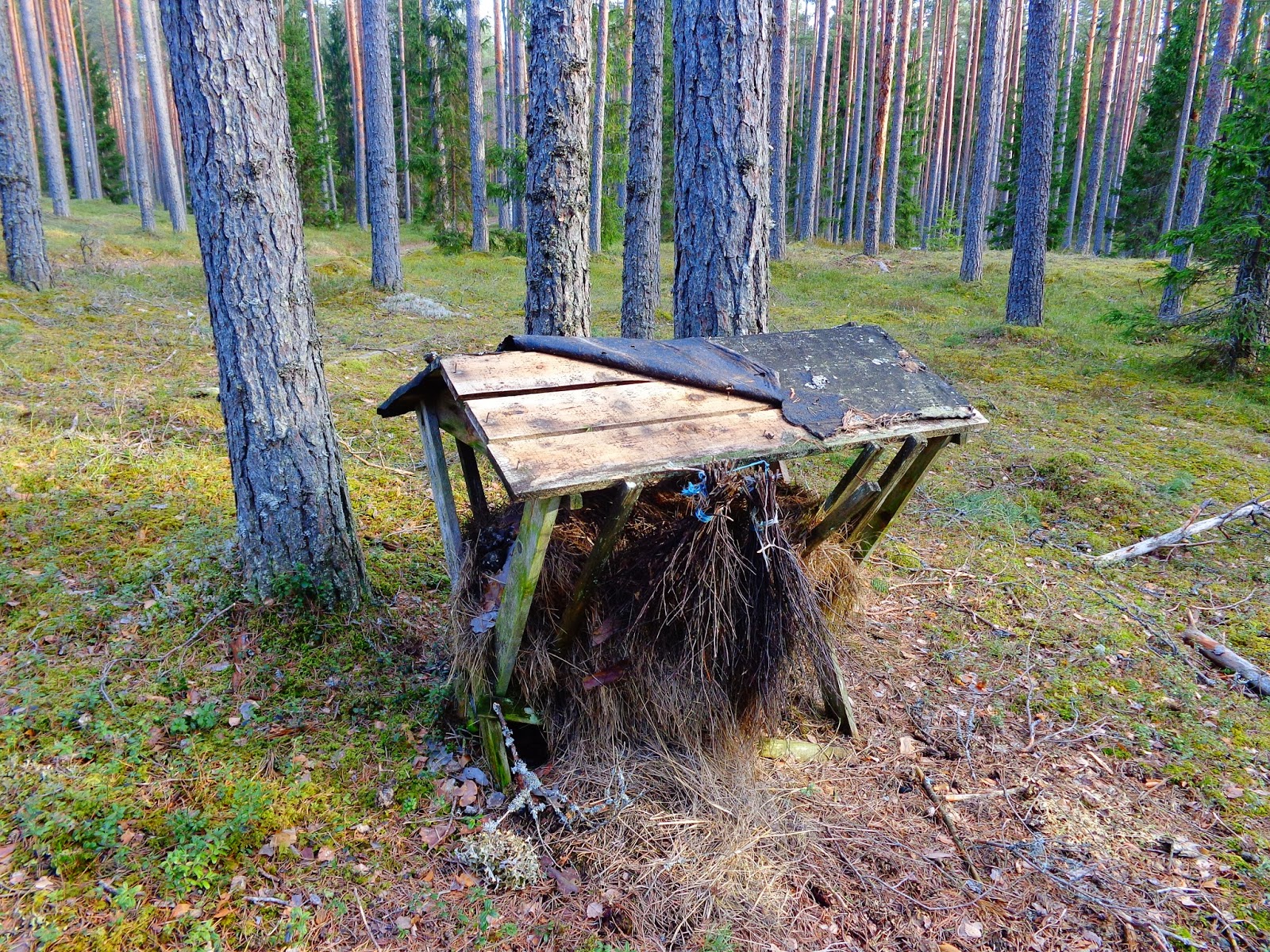
Restaurant for Animals


During winter, wild animals may end up starving. There's some stuff around, like treebark, frozen grass under the snow. Wild boars dig up leftover potatoes from fields, deer and rabbits come near houses and munch on young trees that people have planted a year before... But near the spring it's pretty hard as most of the resources are exhausted. Predators (wolves, foxes, lynx) are hungry, too, unless sleeping as bears do.
That is why humans, mostly represented by the hunting club members, serve the forest dwellers the high cuisine of potatoes, perfectly dryed hay and selected branches from young apple trees. Special animal feeding "restaurants" are built.
The whole are of Kääpa (Välgi) nature reserve is 2039,8ha of land plus 256,4ha of water. By the way, in spring, parts of the reserve are off limits for the man kind (besides authorised personnel) as the local wild bunch is making babies.
Photos by Vahur Afanasjev 7 March 2014, Välgi nature reservoir.

Monday, February 24, 2014

Independence Day


Cheers for the Estonian Independence Day! (Starring: spicy sprats on rye bread, filled eggs with egg-spratpiss (salty brine) filling, pickles with chillies (pickled by my mother), Moe vodka (from ecologically clean Estonian grain only), fresh tap water (the purest in Estonia) and, as a decoration, some snowdrops (galanthus) I picked in from of my country house earlier today).
Photo and food by Vahur Afanasjev, 24 February, Tartu.

Saturday, February 22, 2014

Weird and Beautiful Ice Vehicles

"Karakat" or "karakatitsa" is a self made vehicle for on-ice fishing. The huge tires (often the inner tyres of large airplanes) make the karakat unsinkable, so one can go winter fishing even if ice conditions are tricky. Each year a Karakatitsa Festival is held in Kallaste.

Karaktitsa is not the only option - some use custom made hovercrafts.


Photos of the Karakatitsa Festival by Vahur Afanasjev, 22 February 2014 in Kallaste, by the Lake Peipsi (Peipus), in the area mostly inhabited by Russian speaking Old Believers who fled to Estonia from repressions in Czarist Russian in 16.-17. century.

Wednesday, January 8, 2014

Funeral & Onions


Movie set in Laosina, Setomaa, South Estonia, 09. 09. 2013. Photo by Aapo Ilves.

Tuesday, January 7, 2014

Simple Magic

DIY - make dress from mens shirt. Photo by Aapo, 21. 09. 2013, Räpina, South-Estonia.

Monday, November 18, 2013

Rock'n'Roll!

Ziggy Wild, Noortebänd 2013 finalist (photo: Kris Moor)

Sunday, October 20, 2013

Plougher

 Retro? No, it's 2009. Photo by Ruti, Hurmi, South-Estonia.

Wednesday, October 16, 2013

When a Finn goes to Latvia

Kalaci, Latvia. 06.10.13 by Mare.

Fear Factor

As all European, and, especially, Eastern European countries, Estonia is full of Le-Corbusier-insiper concrete buildings. Most people hate those... and problably these have the most inhabitant, by percentage. I, personally, rather like the buildings for the straightforward look, logical room planning, economical and environmentally practical central heating. If placed correctly (the distance between two buildings has correspont to be their double height) and surrounded with a touch of nature (grass, tress, bushes, flower beds, playgrounds), they're ok.

But what I hate, is that in 1990ies people took extreme liberties in fucking up the face of these houses, closing the terraces, balconies and loggias any way came to their mind. Oh, well, there's some vernacular coolness about it, too, but in general - it's ugly. What impressed me on this 9-storey house in Tartu Annelinn (Ann's town), is the last floor grated terraces. I guess there was some reason in those metal bars at some point, but the current level of criminality is so low that I hardly imagine somebody breaking in from there and carrying all the stolen stuff (TV set?) away over the roof... On the other hand, in the mid 1990ies, there was a wave of stealing bikes from 2-3 storey balconies. So maybe I'm just snobbish and the bars have to be there.

By Vahur Afanasjev, Tartu, 2010

Monday, October 14, 2013

Karakatitsa


If  lake Peipsi (not to be confused with Pepsi) is covered with ice (seen already melting and piling on the photos) but you still feel you want to go fishing, you need a karakatitsa.


There's Russia on the other shore. And the April ice can move big stones and pull up trees on its way. Just like the ice in "Ice Age" animated film.


Karakatitsa is a rebuilt car, something like a monster truck, only it's not a heavy show off job, but rather a light and practical vehicle. The point is, it has to stay float, even if the ice breaks. Internal tires of airplanes are most commonly used to the wheel - and sometimes upgraded for better grip, as seen on the photos.


Photos, by the way, are taken in April 2009, in Nina village (The Nose village) in Eastern / South-Eastern part of Estonia).

Estonian Totoro


April 2010, Kirepi. Photo by Mare Sabolotny.

Saturday, September 7, 2013

NWC Vineyard


Shit is the father of bread, we say. The southern wall of the lavatory (NWC i.e. no water closet) at my mother's summer home has perfect light, temperature and nutritive soil conditions for growring grapes. They ripe in late August - early September. Btw, here it's wise to hide the vine-trees for winter, by covering them with fur-tree branches.


Yes, grapes in Estonia (latitude 59°), meaning almost ten degrees wrong (latitudes 30° to 50° being the "official" boundaries of viticulture). And trust me, they taste good and one can make wine, too, though I'd stick with eating, as the it's a bit cold for the noble wine grape varieties to grow.

Photos: Vahur Afanasjev

Monday, August 19, 2013

Riders on the Grass

Riders on the Grass. Photo by Aapo, 17. 08. 2013, Obinitsa, Setomaa, South-Estonia.

Artist

Artist. Photo by Maive, 16. 08. 2013 in Räpina, South-Estonia

Dog'n'Man

Photo by Aapo, 17. 08. 2013, Obinitsa, Setomaa, South-Estonia.

Estonian Summer

Just hangin' out. Photo by Aapo, 18. 08. 2013, Uusvada, Setomaa, South-Estonia.

Friday, August 16, 2013

Oldschool dj

6th August 2013 in Estonian Road Museum
Photo by Liiso

Wednesday, August 14, 2013

This Guy Loves Milk!

Udder-hat. Nice! Photo by Aapo Ilves, 14. 06. 2013 in Raadamaa, South-Estonia.

On the Yellow Side of the Port

Grab your coat and get your hat 
Leave your worries on the doorstep 
Life can be so sweet 
On the sunny side of the street...
(Dorothy Fields)
Photo by Aapo Ilves, 30. 06. 2013 in Beresje, Setomaa, South-Estonia.

Photographer: I Didn't Come Out of the Closet!

Taking picture of strange graffiti in abandoned house near Kabli, South-West-Estonia. Photo by Aapo Ilves, 25. 07. 2013.